Squint Eye Treatment in Adults: Types, Causes, Symptoms & Treatment Options
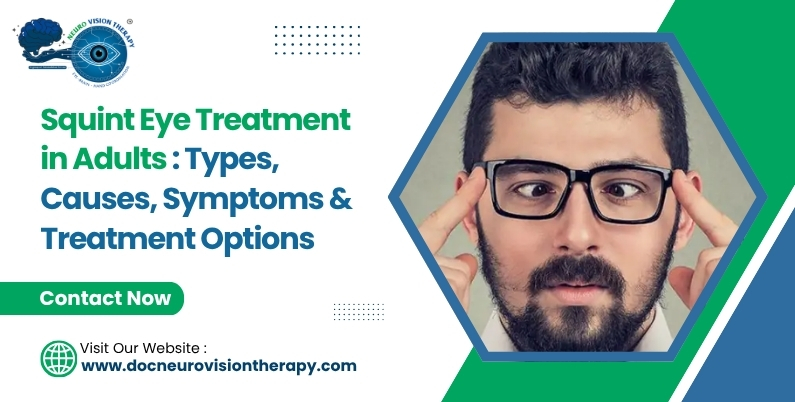
Squint Eye Treatment in Adults
Many people assume that squint eye, also called strabismus, is only a childhood condition. In reality, adults can also develop eye misalignment due to untreated childhood squint, nerve problems, medical conditions, trauma, or muscle imbalance. When this happens, it can affect not only appearance but also vision and daily comfort. The good news is that modern eye care offers several effective solutions for Squint Eye Treatment in Adults, including prism glasses and vision therapy.
At Neuro Vision Therapy, we provide comprehensive neuro-optometric rehabilitation designed to improve the connection between the eyes and the brain. Our personalized therapy programs focus on enhancing eye tracking, focusing, binocular vision, visual processing, and eye-brain coordination, helping both children and adults achieve better visual performance and quality of life
What is a Squint Eye?
A squint eye occurs when both eyes do not point in the same direction at the same time. Normally, the eyes work together as a team so the brain can combine the images from both eyes into one clear picture. In strabismus, one eye may drift away from the target while the other eye focuses correctly.
This misalignment can be constant or intermittent. It may affect one eye all the time or alternate between both eyes. Because the eyes are not aligned properly, the brain may struggle to merge the two images, leading to visual discomfort or double vision.
Can Adults Develop a Squint Eye?
Yes, adults can develop squint eye even if they never had it in childhood. Some adults also experience a return of a childhood squint that was previously controlled or unnoticed.
Adult-onset squint should never be ignored because it may be linked to conditions such as stroke, thyroid disease, diabetes-related nerve damage, head injury, or brain disorders. A prompt eye examination is important to identify the cause and begin treatment early.
Causes of Squint Eye in Adults
Adult squint can happen for several reasons. Some of the most common causes include:
1. Untreated Childhood Squint
Some adults have had a squint since childhood, but it was never fully corrected. Over time, the eye misalignment may remain stable or become more noticeable.
2. Stroke
A stroke can affect the nerves or brain areas that control eye movement. This may lead to sudden squint, double vision, or difficulty moving one eye properly.
3. Diabetes
Diabetes can damage the nerves that control the eye muscles. This nerve damage may cause sudden eye misalignment and double vision.
4. Head Injury
An injury to the head or face can damage the muscles, nerves, or bones around the eyes. This may result in a squint that appears immediately after trauma or develops later.
5. Thyroid Eye Disease
An overactive thyroid can cause swelling and inflammation around the eye muscles. This may restrict eye movement and lead to misalignment.
6. Brain or Neurological Disorders
Conditions affecting the brain or nervous system can interfere with the coordination of eye muscles. In such cases, squint may be one of several symptoms.
7. Eye Muscle Weakness or Paralysis
If one or more eye muscles become weak or paralyzed, the eyes may no longer move together properly, causing a squint.
Types of Squint Eye in Adults
Understanding the type of squint is very important because each type behaves differently and may need a different treatment plan. Below is a detailed explanation of the main types seen in adults.
1. Esotropia
Esotropia is a type of squint in which one eye turns inward toward the nose while the other eye looks straight ahead.
2. Exotropia
Exotropia occurs when one eye turns outward, away from the nose.
3. Hypertropia
Hypertropia is a vertical squint in which one eye turns upward compared with the other eye.
4. Hypotropia
Hypotropia is the opposite of hypertropia. In this condition, one eye turns downward compared with the other eye.
5. Intermittent Squint
In intermittent squint, the eye is aligned properly at times but drifts out of position occasionally.
6. Constant Squint
In constant squint, the eye remains misaligned most or all of the time.
7. Paralytic Squint
Paralytic squint happens when one or more eye muscles stop working properly because the nerve supply is affected.
Symptoms of Squint Eye in Adults
Symptoms may vary depending on the type and cause of the squint. Common signs include:
- Double vision
- One eye turning inward, outward, upward, or downward
- Blurred vision
- Eye strain
- Headaches
- Difficulty focusing
- Poor depth perception
- Trouble judging distances
- Closing one eye while reading or watching TV
- Tilting the head to see better
- Fatigue during visual tasks
Best Non-Surgical Treatment Options for Squint Eye in Adults
Treatment depends on the cause, type, severity, and duration of the squint. Some adults may improve with non-surgical methods, while others may need surgery.
1. Vision Therapy
Vision therapy uses customized exercises to improve eye coordination, focusing, tracking, and binocular vision.
It may help with:
- Eye teaming problems
- Convergence insufficiency
- Mild alignment issues
- Visual comfort during reading or screen use
Vision therapy is not suitable for every type of squint, but it can be very useful in selected adults.
2. Prescription Glasses
If refractive errors such as farsightedness or astigmatism are contributing to the squint, glasses may improve alignment and reduce strain.
3. Prism Glasses
Prism lenses help redirect light so the eyes can work together more comfortably. They are often used to reduce double vision and visual discomfort.
Is Vision Therapy Effective for Adults?
Yes, vision therapy can be effective for many adults, especially those with binocular vision problems, convergence insufficiency, or mild coordination issues. However, it does not correct every type of squint.
The success of therapy depends on the exact diagnosis. A qualified eye care professional can decide whether exercises alone are enough or whether additional treatment is needed.
Conclusion
A squint eye treatment in adults is not just a cosmetic concern—it can significantly affect vision, confidence, comfort, and daily activities. In some cases, it may also indicate an underlying neurological or medical condition that requires prompt evaluation.
The best outcomes are achieved through early diagnosis and a personalized treatment plan. Depending on the cause and severity, treatment may include prescription glasses, prism lenses, vision therapy, or surgery. Neuro Vision Therapy complements these treatments with specialized neuro-optometric rehabilitation programs that strengthen eye-brain communication, improve binocular vision, visual processing, eye tracking, and overall visual efficiency through evidence-based therapeutic techniques.
FAQs
1. Can adults recover from a squint eye?
Yes. Many adults improve with glasses, prism lenses, vision therapy, botulinum toxin, or surgery, depending on the cause and severity.
2. Can vision therapy cure squint?
Vision therapy can help certain adults, especially those with eye coordination problems. However, some forms of squint need surgery or other treatments.
3. Does adult squint always need surgery?
No. Some adults improve with non-surgical treatments such as glasses, prism lenses, or vision therapy. Surgery is considered when these options are not enough.
Our Mission
We work collaboratively with each child to strengthen visual skills, improve attention and concentration, and enhance overall visual comfort and efficiency.
Contact :
Phone: +91 97030 57772
Email: neurovisiontherapy2023@gmail.com
Categories
Recent Posts
Schedule An Appointment
- ←
-
Contact Us
Contact Form
- Phone